Transportation and Specialized Field Tests
WIM Field Tests
Real-road validation of high-speed WIM sensing, vehicle-event detection, and vehicle-level monitoring records.
Site Overview
The WIM field tests were conducted to validate high-speed Weigh-in-Motion sensing under real roadway conditions rather than controlled laboratory loading. The campaigns focused on capturing short-duration tire-sensor interactions from moving vehicles and converting raw roadway signals into interpretable vehicle-level records, including axle events, gross-weight estimates, passage timing, and reviewable monitoring outputs.
Field locations
- Saemangeum
- Bongdong
Sensor / Equipment Setup
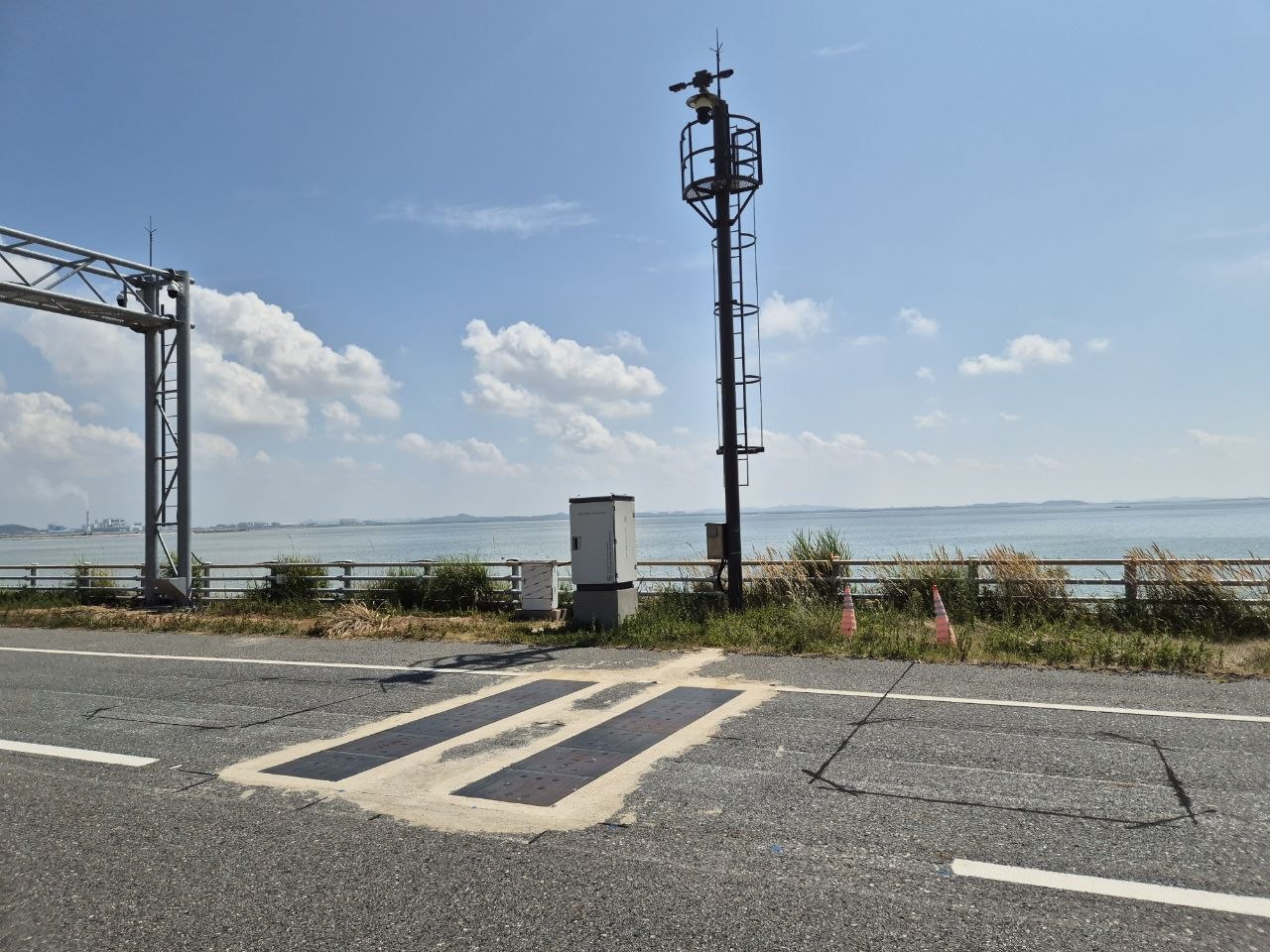
- Multi-channel roadway WIM sensor array installed across operational traffic lanes
- Two-row load-sensing configuration used to compare repeated axle measurements from the same vehicle passage
- Roadside vehicle-detection and image-acquisition workflow for associating WIM events with vehicle records
- DAQ and database workflow for reviewing raw, filtered, and vehicle-level WIM records
Development Highlights
- Reviewed field installation conditions, sensor-channel mapping, signal quality, and vehicle-event acquisition under live traffic
- Processed WIM signals using baseline correction, filtering, smoothing, event segmentation, and channel-level response checks
- Analyzed axle peaks across multiple rows and channels to support axle-event matching and vehicle-passage interpretation
- Linked signal records with vehicle speed, axle configuration, image records, and monitoring outputs where available
- Prepared visualization and validation workflows for reviewing axle loads, gross vehicle weight, channel balance, timing differences, and abnormal waveforms
Validation Workflow
- Field records are organized around the complete WIM monitoring path, from roadway installation and channel mapping to axle-event detection and vehicle-level record generation.
- Representative passages are reviewed through raw signal acquisition, baseline correction, filtering, event segmentation, cross-row axle matching, and monitoring-record creation.
- Validation outputs are separated into signal-quality review, vehicle-event interpretation, and reference-comparison results so exploratory waveform analysis is not presented as certified performance evidence.
Installation Photo
Monitoring Results
- Multi-channel WIM waveforms with detected axle-event intervals
- Cross-row axle matching and timing-difference review between repeated sensor measurements
- Channel response comparison for checking wheel-path effects, noise, drift, and abnormal signal shapes
- Vehicle-level monitoring records combining WIM results, passage timing, vehicle information, and image-based review
Signal Processing and Event Detection
- Raw and filtered WIM signals can be used to show how short-duration wheel-load responses are segmented into axle events.
- Cross-row axle matching can document timing consistency between repeated sensor measurements for the same vehicle passage.
Validation Results
- Reference-weight comparison plots or compact validation tables should be added only for approved datasets and clearly labeled by test campaign.
- Channel-health summaries can show noise, drift, abnormal waveforms, and response imbalance without overstating performance claims.
Operational Monitoring
- Dashboard screenshots can connect passage time, vehicle image, speed, axle configuration, axle loads, gross weight, and system status into a single reviewable record.
- A field-test video would be most useful if it synchronizes the vehicle crossing, WIM signals, detected axle events, and dashboard output.
Field Context
These tests show the field-facing side of my WIM research: connecting embedded roadway sensing, DAQ configuration, signal processing, vehicle-event detection, image-linked records, and dashboard-oriented review. The work supports data-driven infrastructure monitoring by turning real traffic loading into structured records that can be used for overload screening, traffic-load characterization, sensor-health review, and bridge or roadway load assessment.