Transportation and Specialized Field Tests
Prefab Member Transportation Monitoring
Full-scale validation of a portable multimetric sensing system during the lifting and road transportation of a precast concrete deck panel.
Site Overview
The field experiment validated a precast delivery monitoring system (PDMS) on a 12.14 m-long concrete deck panel at the Bricon R&BD plant in Chungbuk. The asymmetric panel, which varied from 240 to 360 mm in thickness, was monitored through ground resting, crane lifting, truck resting, road transportation, and return handling. The test examined whether a portable system could continuously capture the structural response needed to assess lifting balance, transport vibration, strain demand, and support-condition effects.
Sensor / Equipment Setup
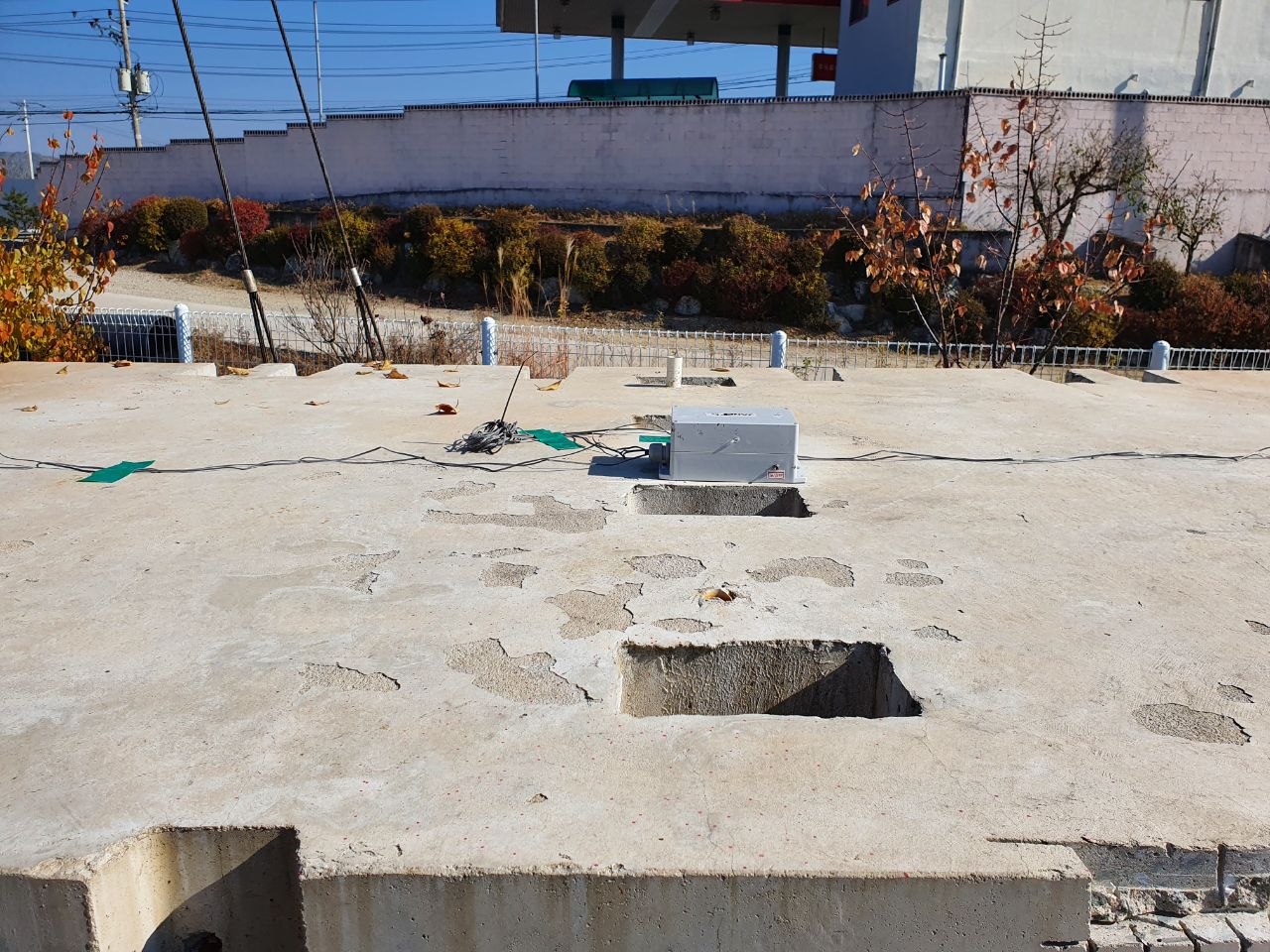
- Portable PDMS integrating a Teensy 4.1 MCU, multichannel ADC, ADXL354 three-axis accelerometer, three 120-ohm concrete strain gauges, and SD-card storage
- Six-channel data acquired at 1,000 Hz, low-pass filtered with an FIR filter, and downsampled to 100 Hz for continuous recording
- Six rechargeable 18650 batteries providing 21,000 mAh capacity; measured system current was 165.5 mA, corresponding to an estimated 4.2 days of continuous operation
- Thin steel plates bonded to the concrete with epoxy and a four-magnet sensor mount, avoiding direct permanent fixation of the enclosure to the panel
Development Highlights
- Developed a self-contained multimetric logger that operated without a base-station computer during lifting and transportation
- Used a lifting-stage finite-element model to place three strain gauges near predicted zero-strain locations and establish a reference for absolute-strain offset correction
- Converted three-axis acceleration into panel tilt and combined measured top-surface strain with the FE neutral axis to estimate bottom-surface strain
- Structured the safety assessment around a 133 microstrain cracking threshold, with low-, medium-, and high-risk bands for transport review
Field Validation Workflow
- The delivery sequence covered ground resting, eight-point crane lifting, truck resting, road transportation, a second truck-resting period, return lifting, and final ground resting.
- Three-axis acceleration was recorded continuously for 80 minutes; stage timing was used to separate handling response from road-induced vibration.
- Raw strain was adjusted using the near-zero lifting condition, then compared with the calculated cracking strain limit and FE-estimated bottom-surface response.
- Field and FE results were compared to explain how uneven timber-support contact changed strain distribution in both ground- and truck-resting stages.
Installation Photo
Monitoring Results
- The vertical axis showed the strongest transportation vibration, with a 48.62 mg standard deviation and a 682.59 mg peak; measured peaks remained below the road-transport vibration limits used in the study.
- Pitch and yaw shifted to approximately 2.1 and -0.5 degrees during lifting and remained stable, indicating balanced lifting without overturning or force transfer between cables.
- Offset-adjusted top strain reached 127 microstrain in the ground-resting stage, while the estimated bottom strain at S3 reached 195 microstrain and exceeded the 133 microstrain cracking threshold.
- Only three of seven timber supports were found to be in effective contact on the truck; the FE study indicated that five evenly spaced, fully contacted 100 mm supports could keep strains below 50 microstrain.
Dynamic Response
- Acceleration and tilt histories separated the stationary, lifting, truck-resting, and transportation stages while confirming stable lifting behavior.
- Short-duration acceleration peaks were evaluated against the transport limits cited in the paper rather than treated as damage indicators by themselves.
Strain and Support Assessment
- Offset correction exposed high-risk strain that was not visible when the initially zeroed raw strain was interpreted directly.
- Field observations and FE models linked uneven strain distribution to incomplete timber-support contact beneath the asymmetric panel.
Related Publication
Field Context
This case extends structural monitoring from fixed infrastructure to a moving construction component. It shows that reliable delivery assessment depends not only on recording vibration, but also on reconstructing meaningful strain from installation offsets and interpreting the contact condition beneath an asymmetric member. The study used post-processed field data rather than real-time cloud decision support; online anomaly alerts were identified as future work.