Transportation and Specialized Field Tests
OBM Field Validation
Vehicle-mounted sensing validation for dynamic operating-weight estimation and WIM comparison.
Site Overview
The OBM field validation focused on evaluating an on-board monitoring system installed directly on a heavy vehicle. Unlike roadway WIM systems, which observe tire loads at a fixed road section, OBM records load-related vehicle responses during driving. The validation examined whether vehicle-mounted sensing could provide stable and interpretable operating-weight information under real driving, loading, and road-input conditions.
Sensor / Equipment Setup
- Vehicle-mounted mass-sensing unit, inertial measurement unit, and electronic control unit for on-board data acquisition
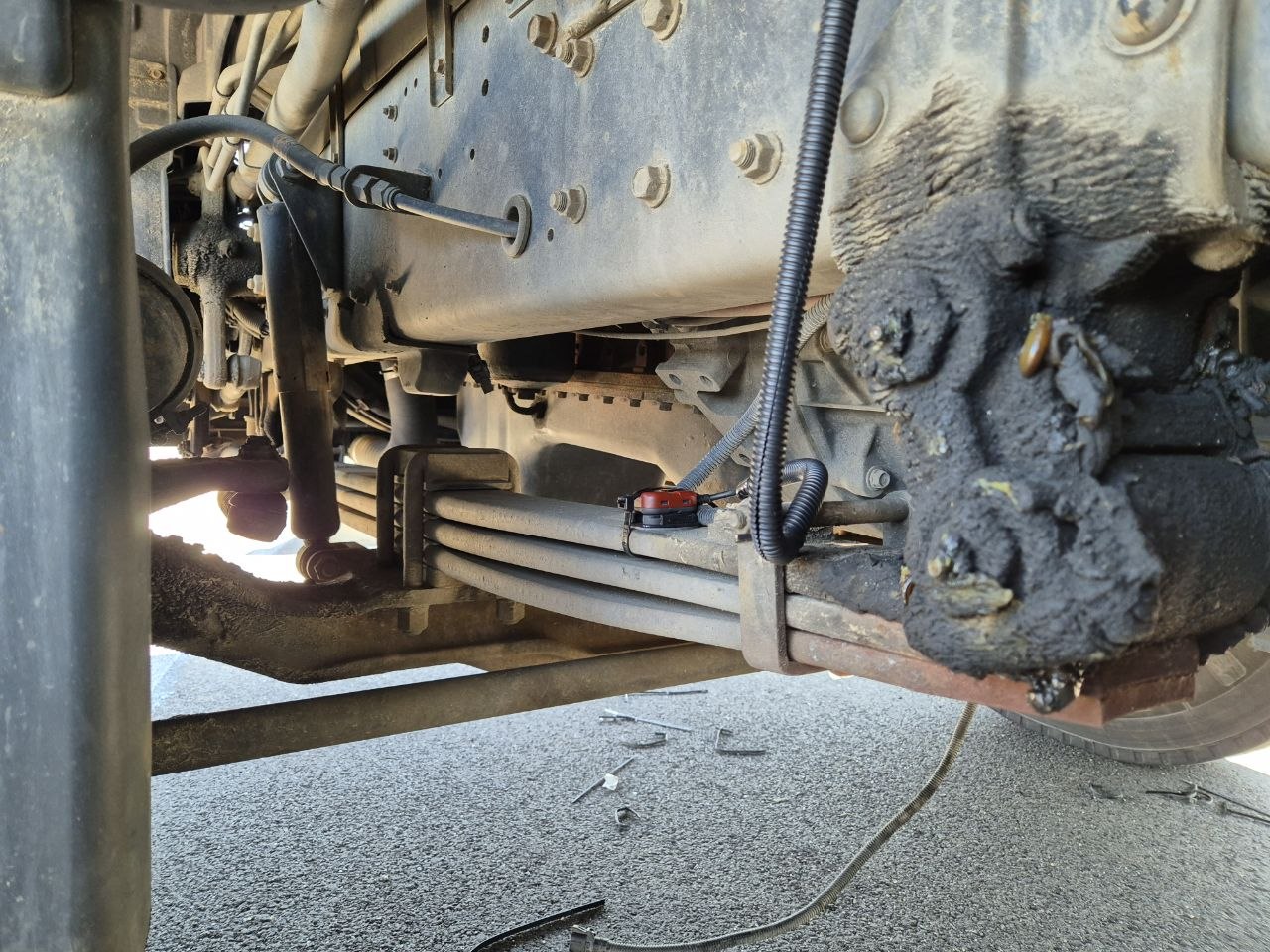
- Underbody installation with wiring, sensor attachment, and vehicle-side logging during repeated driving tests
- Camera-based observation workflow for reviewing suspension or axle movement during selected runs
- Validation workflow linking OBM records with roadside WIM measurements and known loading conditions where available
Development Highlights
- Supported vehicle sensor installation, cable routing, equipment checks, and pre-test inspection for field driving runs
- Reviewed ECU and DAQ settings, channel definitions, timestamps, logging intervals, and data-storage formats
- Preprocessed vehicle-mounted signals using filtering, offset removal, resampling, event segmentation, and invalid-data screening
- Compared OBM responses across loading and driving conditions to evaluate repeatability, drift, dynamic variation, and speed-dependent behavior
- Aligned OBM records with WIM vehicle passages to compare vehicle-side load estimates with roadway-based axle-load measurements
- Reviewed relationships among mass-sensing signals, IMU response, suspension movement, vehicle speed, loading condition, and WIM reference records
Validation Protocol
- Validation records are organized around vehicle instrumentation, loading condition, driving condition, reference measurement, and repeated field runs.
- OBM, IMU, underbody video, and roadside WIM records are compared after passage matching, timestamp alignment, filtering, and stable-window selection.
- Static mass, vehicle-mounted OBM estimates, and instantaneous roadside WIM axle forces are treated as related but distinct quantities during interpretation.
Installation Photo
Monitoring Results
- Vehicle-mounted mass-sensing and inertial response signals collected during field driving tests
- Load-condition and speed-dependent response comparisons across repeated runs
- Time-aligned OBM and WIM records for the same vehicle passages
- Suspension-motion observations and sensor-fusion review linking vehicle response with load-related measurements
Multi-Sensor Signal Processing
- Time-aligned OBM, IMU, speed, and vehicle-operation signals can show how load-related behavior is separated from acceleration, braking, vibration, and road excitation.
- Underbody video frames and marker-tracking results can support physical interpretation of suspension or axle motion during selected runs.
Reference and Cross-System Validation
- OBM estimates should be compared with static reference weights, roadside WIM records, or both, while clearly stating the physical meaning of each reference.
- Matched OBM and WIM passages can show the same vehicle-road interaction from both vehicle-mounted and infrastructure-mounted sensing perspectives.
Test Matrix
- A compact table should summarize vehicle configuration, loading condition, speed condition, road section, reference method, and repeated runs once those details are finalized.
- Validation plots should distinguish approved performance metrics from exploratory signal-processing or synchronization checks.
Field Context
This validation expands my field experience from fixed infrastructure sensing to vehicle-mounted monitoring. It connects sensor installation, embedded acquisition, vehicle dynamics, signal synchronization, video-based motion review, and WIM comparison around the same load-observation problem. Together with the WIM field tests, the OBM work supports a broader research direction in data-driven infrastructure evaluation under actual operating conditions.